
Most venues don't lose money on bottle service because demand is weak. They lose it in the gaps: a table sold twice on a busy Saturday, a deposit that never got collected, a host scrolling three apps at the door while a line builds behind the rope. Bottle service table reservation software is supposed to close those gaps. The problem is that "reservation software" covers everything from a restaurant booking widget with a VIP tab bolted on to a full nightlife operations platform that handles floor plans, deposits, guest lists, and door check-in in one place.
This list ranks seven platforms an operator can actually buy today. The ranking lens comes from the five things that decide whether a night runs clean: how deposits are collected and reconciled, how tables map to a real floor plan, whether guest profiles carry history between visits, how fast check-in moves at the door, and what the software takes out of each sale. A platform that nails four of those and taxes every ticket is a different purchase than one that does three well and leaves your margin alone.
How These Seven Platforms Were Ranked
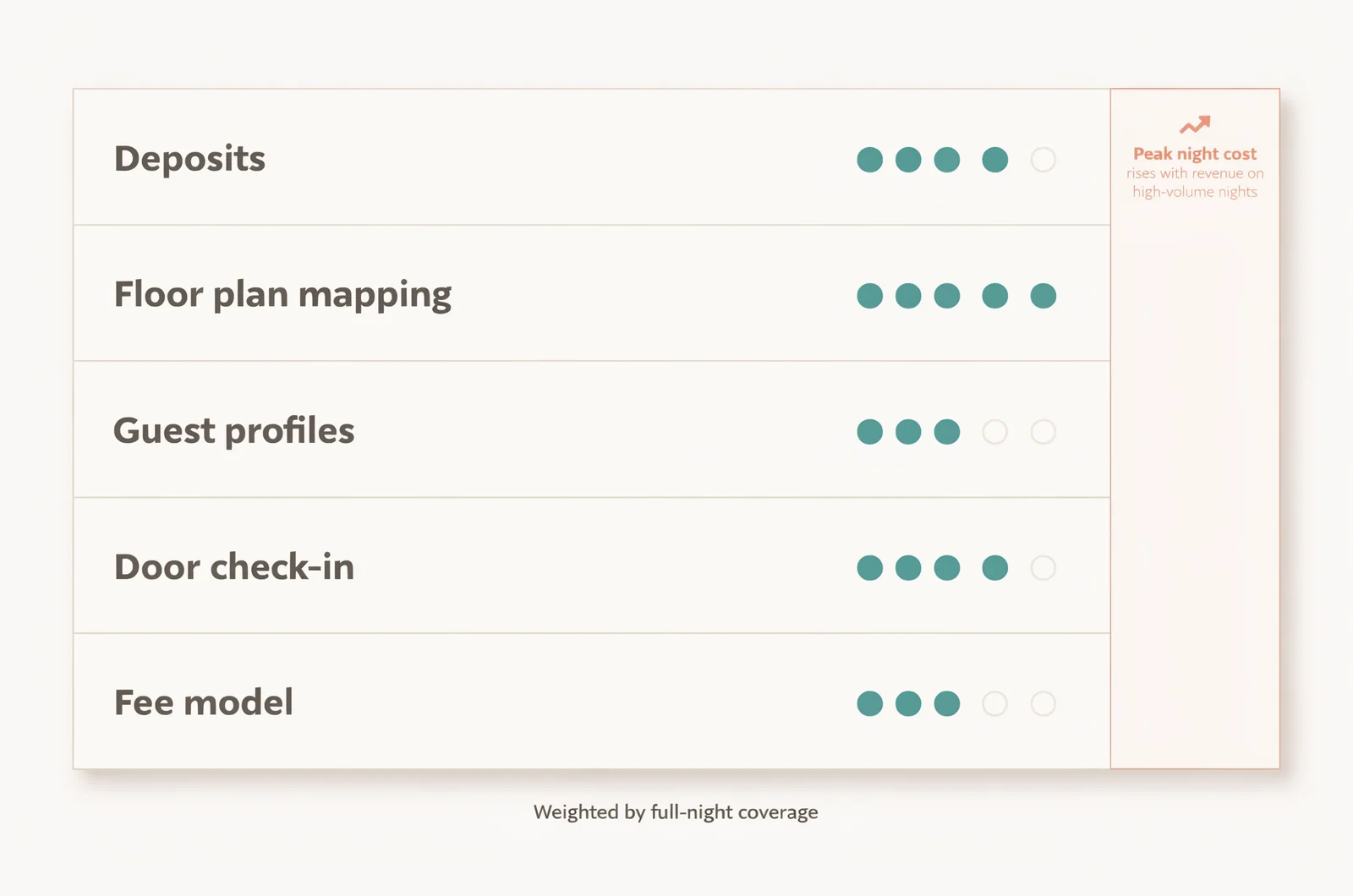
The scoring rule is simple: a platform earns a higher position when it handles the whole night, not just the booking. That means tickets and tables can sell side by side, deposits come in without a phone call, the floor plan matches the room, the door scans guests in seconds, and the morning-after report reconciles what was sold against what was collected.
Fees matter as much as features. A percentage-of-sales model costs more on your best nights, which is exactly backwards for a venue whose revenue spikes on holidays and holiday weekends. Flat pricing and no cut of ticket sales carry real weight here.
Two caveats before the list. First, vendor pricing and feature tiers change; confirm current terms directly before signing. Second, none of these platforms is a fit for every room. A 200-capacity lounge and a 3,000-capacity beach club have different failure modes, and the verdict on each entry says who it suits.
1. DQ Bottle Service Software
DQ is the most bottle-service-specific tool on this list, and that focus shows. It's built for venues and VIP teams that live on table spend rather than general admission, with ordering, payments, bookings, and incident tracking in one system. The platform collects full table guest lists and displays spend against each table, which is the number a host actually needs when a guest asks whether they've hit their minimum.
Where it earns the top spot: the workflow assumes bottle service is the business, not an add-on. Guest lists, spend tracking, and incident logging sit in the same place, so a manager can see a table's history without cross-referencing a spreadsheet.
The limitation is scope. DQ is a strong fit for nightclubs and VIP-focused rooms, but if you also run general-admission ticketing at volume, you'll want to check how deep that side goes before committing. It's also a smaller player than the restaurant-booking giants, so integration options are narrower.
Verdict: Best for clubs where table revenue is the whole game and the VIP team needs one screen for lists, spend, and incidents.
2. POSH
POSH treats tables as a ticket type, which sounds like a technical detail until you see what it unlocks. When tables are enabled, a Tables section appears on the event page below standard ticket options, with a custom aerial table map that lets guests pick their own spot. Prospective buyers can click a table to see details before purchasing, and staff can create, remove, or edit table statuses at any time — purchased tables lock, which prevents the double-booking problem at the source.
The seating-map side is where POSH gets specific. You upload a custom floor plan, define what each package includes (three premium bottles, a dedicated server, a stage view), set a seating limit per reservation, and control how many identical tables exist at each pin location. Entry is enforced through a barcode tied to the primary buyer's profile, so a host can manage group entry at the VIP gate and hold the line on capacity.
That structure — package description, seating limit, quantity, price — is the cleanest published example of how table inventory should be configured. If you want to see the mechanics in detail, POSH's documentation on Offering Table Service: Creating Your seating map walks through the setup, and the Tables Bottle Service overview covers how the event page changes once tables go live.
Limitation: the table infrastructure is strong, but the surrounding nightlife operations — door flow at scale, multi-venue reporting — depend on how you've configured the rest of the platform.
Verdict: Best for venues that sell tables as premium inventory on a public event page and want guests choosing their own booth.
3. PourHUB
PourHUB leads with floor control, and the pitch is direct: visual floor plans, table reservations, and VIP bottle service tracking so you know what's happening on the floor at all times. The drag-and-drop floor plan builder and real-time table status tracking are the core of it, and minimum spend tracking per table is built in rather than bolted on.
The published feature tiers show where the walls are. Table and floor plan management, e-ticketing with QR codes, email and SMS delivery, guest list management, and POS integration sit in the middle tier, not the entry plan. Multi-location management, advanced table management, and unlimited POS integrations sit above that. For a single-room venue, the middle tier covers the essentials; for a group running three rooms, the jump is real money.
PourHUB also carries pour cost and variance analysis, which matters more to a bar program than to a door team. If your beverage director and your reservations manager currently use different systems, that overlap is worth something.
Limitation: the tiered structure means the features that make the platform useful for bottle service aren't in the cheapest plan, so compare total cost rather than entry price.
Verdict: Best for bars and clubs that want floor visibility and pour-cost analysis in the same tool.
4. Mr. Black
Mr. Black positions itself as free software for nightclubs and bars, covering reservations, guest list, and tables. For a small venue testing whether software beats a paper book, the price of entry removes the main objection. The platform's stated goal is increasing guestlist and bottle service reservations while cutting manual work at the door.
Free is a real advantage and a real constraint. Free tools tend to monetize somewhere — through transaction fees, upsells, or limits on volume — and the published material doesn't spell out where those limits sit. That's not a reason to skip it; it's a reason to read the terms carefully before you move your Saturday-night table inventory onto it.
Limitation: limited published detail on fee structure and reporting depth makes it hard to judge at scale.
Verdict: Best for a single-room venue that wants to get off spreadsheets without a monthly commitment, and is willing to verify the terms.
5. UrVenue
UrVenue comes at the problem from the experience-packaging angle. The company's platform targets lifestyle and hospitality venues, and its stated focus is helping operators expand beyond traditional reservations by packaging and preselling curated experiences that generate revenue before guests arrive. That framing matters for beach clubs, day clubs, and resort venues where the product isn't just a table — it's a cabana, a poolside package, a staged arrival.
The company has been showing this at industry events, including the 2026 BAR & Restaurant Expo, where it demonstrated how operators monetize space more creatively while reducing manual operational work. If your revenue mix includes presold experiences rather than walk-up table sales, that orientation is closer to your business than a restaurant booking engine.
Limitation: the experience-packaging strength is less relevant to a straight nightclub that sells tables and bottles and nothing else.
Verdict: Best for beach clubs, day clubs, and resort venues selling packaged experiences, not just tables.
6. SevenRooms
SevenRooms is the heavyweight on this list, and its research arm publishes some of the most useful data in the category. The company's 2026 restaurant trends report found that 22% of consumers now use AI to discover restaurants, while 64% of diners still call to book — and 40% of those calls go unanswered. That last number is the one to sit with: nearly half of the people who pick up the phone to book never get through.
For bottle service specifically, SevenRooms holds the floor plan and the guest profile, which is the layer that matters when a regular calls and expects the host to know their usual booth. The platform's strength is guest memory and CRM depth across visits.
Limitation: SevenRooms is built around the restaurant reservation model first. Nightclubs with heavy bottle service and door-flow demands should test whether the VIP and check-in workflows match how their room actually runs.
Verdict: Best for venues with a restaurant-adjacent operation and a guest base worth remembering in detail.
7. Speakeasy
Speakeasy raised $8.8M to build what it calls an intelligence layer for live events, and its client list — Fontainebleau Development, E11EVEN, Cipriani, Breakaway Music Festival — tells you where it plays. The company reports 500% year-over-year growth and near profitability before taking outside capital.
The platform combines ticketing, reservations and table management, premium booking experiences, payments, POS integrations, CRM, marketing, and analytics in one system, aimed at nightlife, sports and entertainment, festivals, membership clubs, and live events. That breadth is the appeal: a venue running both a club night and a festival activation can keep one guest record across both.
Limitation: the platform is aimed at larger operators, and pricing isn't published. Smaller venues may find it more system than they need.
Verdict: Best for multi-property operators and festival-adjacent venues that need one record across several event types.
What the Category Gets Wrong About Fees
The pricing model matters more than the feature list, and it's the thing operators underweight during evaluation. A platform that takes a percentage of ticket sales costs you more on your biggest nights — New Year's Eve, festival weekends, the holiday party season — which is precisely when you can least afford the tax. A flat monthly fee inverts that: your cost stays fixed while revenue climbs.
The second trap is tier gating. Table and floor plan management, guest list tools, and reporting are the features that justify the purchase, and they're frequently locked above the entry plan. Compare the tier that includes what you actually need, not the advertised starting price.
The third is reconciliation. If deposits, table spend, and ticket sales land in three different reports, someone on your team is rebuilding the night in a spreadsheet every morning. Software that can't produce one number for the night hasn't solved the problem it was bought for.
What to Check Before You Commit
Run these five tests against any platform on your shortlist, in this order.

Sell a table and a ticket in the same transaction flow. If the two systems don't see each other, you'll be reconciling them manually forever. The case for running tickets and tables on one system is mostly about what happens after the sale.
Take a deposit on a real booking. Watch how the request goes out, how the guest pays, and where the money shows up. If the process needs a phone call or a manual invoice, it won't survive a busy Friday. A clean request deposit flow should run without staff intervention.
Build your actual floor plan. Not a demo room — your room, with your booths, your bar, your stage sightlines. A floor plan setup that takes an afternoon to configure is a warning sign.
Scan a guest in at the door. Time it. If check-in takes more than a few seconds per guest, the line will back up at 1 a.m. and your door staff will abandon the scanner. The goal is a door that keeps moving even at peak.
Pull the morning-after report. Look for table spend, deposits collected, no-shows, and attendance in one view. If you're exporting to a spreadsheet to answer basic questions, the reporting isn't finished.
If you want a structured way to run these tests, build a one-page scorecard: five criteria, one to five points each, scored after a live test night rather than a sales demo. A platform that scores well in a demo and poorly on a Saturday isn't a fit, no matter how the feature list reads.
Questions Operators Ask Before Switching
Does bottle service software replace my POS? Usually not. Most platforms on this list integrate with a POS rather than replacing it, and the integration depth varies by tier. PourHUB, for example, gates POS integrations by plan level. Check how many systems you can connect before you buy.
Can I sell tables and general admission tickets from the same page? Some can. POSH adds a Tables section directly to the event page below standard ticket types, which is the cleanest version of this. Others require separate flows, which means separate reconciliation.
What happens when a guest cancels a table? Deposit and refund rules are the least standardized part of the category. Test the cancellation path before you commit, and make sure your published policy matches what the software actually does.
Do I need a floor plan before I start? It helps. Table inventory, seating limits, and minimum spends all hang off the floor plan, so building it early saves rework. If you're not sure where to start, the floor management workflow is a reasonable template.
How do I handle a guest who wants their usual table? That's a guest-profile question. If the platform can't surface a returning guest's history and preferred booth at the door, your host is relying on memory — which works until it doesn't.
Where VenueStack Fits
VenueStack runs ticketing, table bookings, deposits, guest lists, check-in, and reporting in one system, which is the same ground the platforms above cover from different angles. The differences worth knowing: one plan includes every feature rather than gating table management behind a higher tier, there's no cut of ticket sales, and the guest list stays in your account.
For venues weighing the switch, the practical starting points are the nightclub bottle service setup and the beach club tables workflow, both of which show how tables, deposits, and door check-in connect. The pricing and fees page lays out the flat model if the percentage-of-sales question is the one holding up your decision.
Picking the Right Platform for Your Room
The ranking above isn't a universal order — it's a fit order. DQ leads for clubs where bottle service is the entire business. POSH leads for venues selling tables as premium inventory on a public event page. PourHUB leads for bars that want floor visibility and pour-cost analysis together. UrVenue leads for beach clubs and resorts selling packaged experiences. SevenRooms leads for restaurant-adjacent rooms with a guest base worth remembering. Speakeasy leads for multi-property and festival operators. Mr. Black leads for the single-room venue that wants off spreadsheets cheaply.
The decision comes down to three questions. Does the platform sell tickets and tables the same night? Does it collect deposits without a phone call? Does the door keep moving when the line is longest? Answer those honestly for each option, check the fee model against your busiest night rather than your average one, and the shortlist usually sorts itself.


